Zelli Handbags
Can technology help fashion produce less?
Fashion's production model creates a difficult contradiction.
Fashion depends on creating desire and predicting demand, yet overproduction remains one of the industry's most persistent waste problems. At the same time, many materials marketed as alternatives to leather carry their own environmental costs.
Zelli explored whether a different relationship between customer, product and manufacturer could be created by producing handbags in response to confirmed demand rather than anticipating it.
What if the point of technology was not just to sell more, but to produce with more intention?
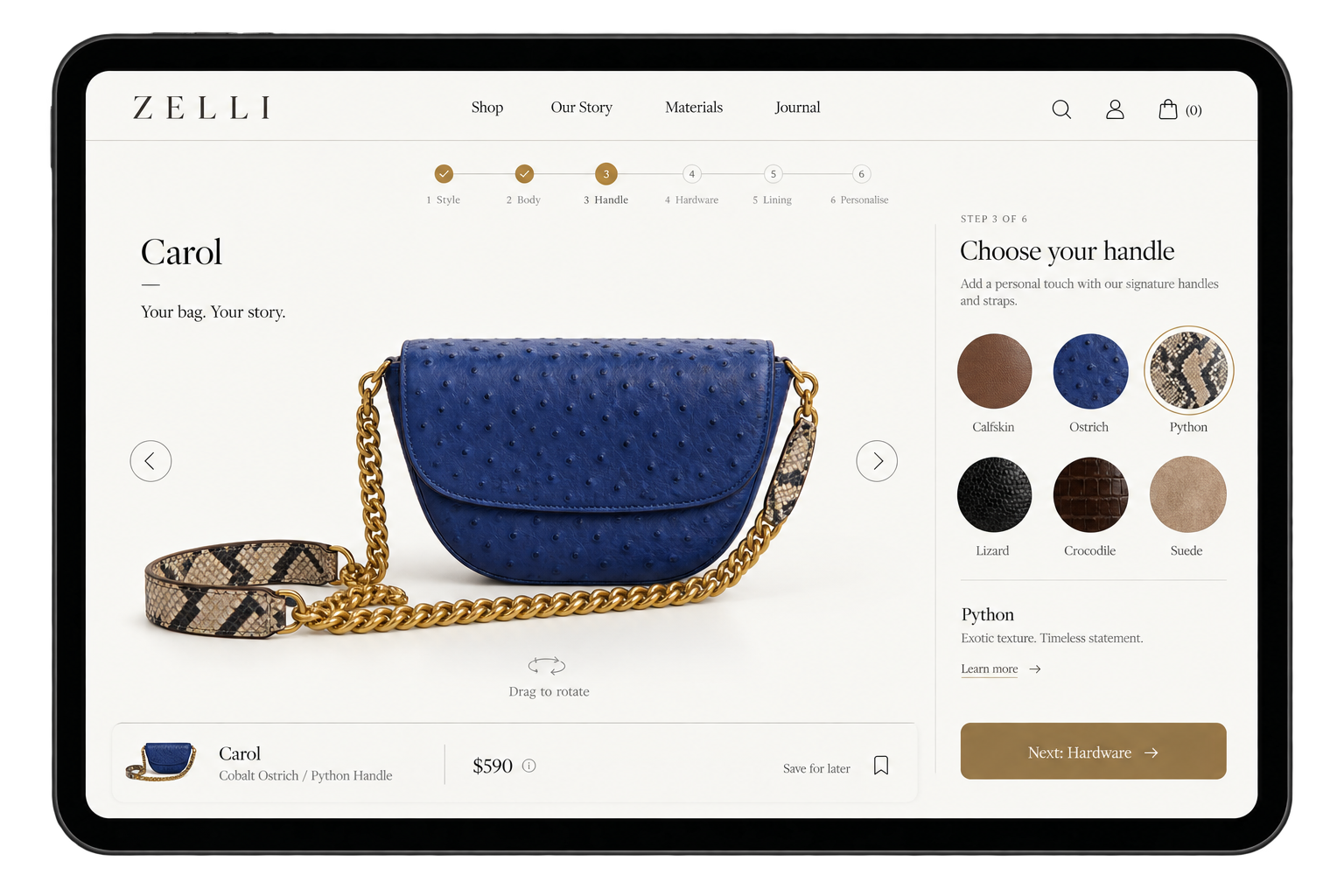
At the centre of Zelli was a 3D configurator that allowed customers to explore, personalise and visualise a handbag before it entered production. The experience was designed to make customisation part of the value proposition while allowing production to respond directly to actual demand.
The work sat between intention and reality.
The project was deliberately not framed as a simple 'sustainable fashion solution'. It examined the trade-offs between technology, personalisation, material choices, production and genuine conservation consciousness.
The challenge was to design an experience that could make a more considered production model desirable rather than treating environmental responsibility as a compromise.
Question the system
Looked beyond the interface to examine how consumer desire connects to manufacturing, inventory and waste.
Design the demand
Used a 3D configurator to make personalisation and anticipation part of the customer experience.
Connect order to production
Explored a made-to-order model where confirmed customer demand could trigger manufacturing rather than speculative inventory.
A fashion concept built around the tension between wanting more and producing less.
Zelli demonstrates a different kind of design thinking: using technology not simply as a feature, but as a way to question an existing system. The project balanced commercial desirability with environmental responsibility and asked whether better experiences could help create more intentional forms of consumption.